Art as a Method to Understand Past and Present Cultures
How art and civilization tin can help us rethink time
(Image credit:
Getty Images
)
What do photographs of ancient organisms, blocks of water ice in the centre of London and the blockbuster Black Panther have to do with the future of humanity? Ella Saltmarshe and Beatrice Pembroke explain.
DEEP Culture
This article is office of a BBC Time to come series about the long view of humanity, which aims to stand up back from the daily news wheel and widen the lens of our current place in time. Modern order is suffering from "temporal burnout", the sociologist Elise Boulding once said. "If one is mentally out of breath all the time from dealing with the present, there is no energy left for imagining the future," she wrote.
That's why the Deep Civilisation flavor is exploring what really matters in the broader arc of human being history and what information technology ways for us and our descendants.
There is a line in Village where the prince of Kingdom of denmark declares, "The fourth dimension is out of articulation." Shakespeare might accept written these words yesterday, not more than 400 years ago, for we alive in a world where our perception of fourth dimension is dislocated. Humanity should be acting to preserve its long-term future. Instead, short-term mindsets and structures boss. We focus on the nowadays day while neglecting problems that will suffer for centuries – from climate change to ecological collapse.
For most of human history we haven't needed to think long-term. It wasn't very useful when we were fugitive attacks from sabre-toothed tigers, desperately foraging for breakfast on the forest floor and surviving extreme conditions weather condition. As futurist Jamais Casio puts it, "In a world of abiding, imminent existential threats, the ability to recognise subtle, long-term processes and multi-generational changes wasn't a especially important adaptive advantage." However today, the nature of risk has changed. We no longer alive in a earth of clear, local crusade and outcome, and the greatest threats to civilisation are happening on the timescale of decades or centuries.
To avoid these dangers, we can't wait for our Neolithic mental functions to play evolutionary catch-up, and then nosotros need to supplement them. While our minds might exist not exist wired to deal with long-term threats and priorities in the abstract, they are wired for two things that we tin can control: story and emotion. Our predisposition towards story, and the securely emotional nature of our controlling, makes fine art and culture foundational to ensuring our time to come as a species.
You might also like:
- The perils of brusk-termism
- The flaw at the centre of democracy
- How and why did religion evolve?
That's why we take established an initiative called the Long Fourth dimension Projection, which champions art and civilization as a route to helping people think and act more long-term. This is about everything from the YouTube videos we watch, to the adverts we curlicue past, to the box-sets we binge, to the art exhibitions nosotros attend, to the theatre we run into, to the clothes we wear and the piece of furniture nosotros utilize. All these fine art forms and creative works are shaped by small "c" culture: the collective values, norms and narratives that underpin and drive our societies. This culture shapes our collective direction of travel, from the kinds of laws we brand, to the technology we develop, to the mode nosotros distribute wealth.
So, how exactly can fine art and culture in this broadest sense expand our perception of time and the futurity?
Fine art can stretch our time frames, helping u.s.a. develop what geologist Marcia Bjornerud calls "timefulness": the ability to locate ourselves within eras and aeons, rather than weeks and months.
There is a growing body of deep time work that locates us in the epic geological history of the Universe, evoking awe and wonder. Photographer Rachel Sussman's book The Oldest Living Things in the World contains photographs of organisms more than ii,000 years old, like the Pando, a quaking aspen tree that has formed a forest-sized colony by cloning itself continuously for the past 80,000 years.
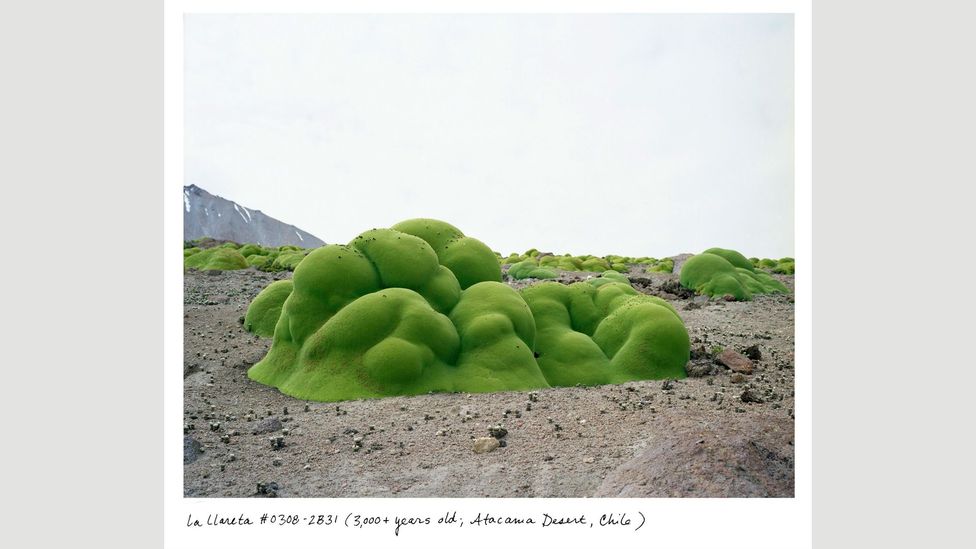
In her photographs, Rachel Sussman captured organisms more than than two millennia quondam (Credit: Rachel Sussman)
Equally Sussman said in an interview with the Marina Abramovic Institute: "My apply of deep time is about creating perspective and differentiating betwixt the shallowness of human timescales and the depth of natural, geologic, and cosmic timescales. It's really meant as a fashion of shifting our perspective… Somewhere along the manner I came to the idea that every problem – personal, societal, anything – can do good from long-term thinking. It's a uncomplicated idea, but information technology asks y'all to slow down and consider long-term consequences before interim."
Sussman is not alone in her fascination with deep fourth dimension. Creative person-technologist Laurels Harger has created a soundscape of the history of the Universe that enables you to hear the "oldest song y'all'll ever hear": the sounds of the cosmic rays left over from the Big Bang. In 2014, the National Academy of Sciences in Washington DC hosted an exhibition called Imagining Deep Time. And so there is the Deep Time walk, an app produced past a scientist, a playwright and a sound designer that enables people to walk 4.6km through 4.vi billion years of history.
Other artists are stretching our time frames forwards, directly engaging with the far future. The Long Now Foundation is building a clock designed to run for x millennia inside a mountain in Texas (read more near the Clock of the Long Now ). And the Longplayer project is a self-extending composition with Tibetan bowls designed by Jem Finer which started on 1 Jan 2000 and will go on without repetition until 2999.
Meanwhile, in 2014, artist Katie Paterson created Time to come Library, a forest planted in Norway which volition supply paper for a special album of books to exist printed in 100 years' time; Margaret Atwood was the beginning writer to manus over a manuscript that won't be read for a century.
All of these works stretch our perspectives, expand our time frames and help the states relocate our beingness in much more epic territory.
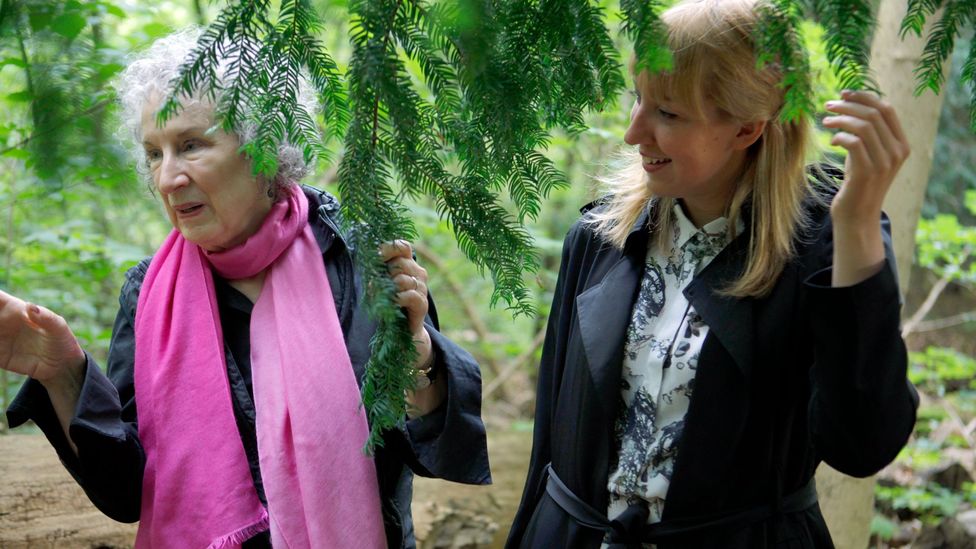
Margaret Atwood and Katie Paterson collaborated to create a story for the Future Library that will non exist read for a century (Credit: Giorgia Polizzi)
Speculative fiction is another way we tin can stretch our time frames through culture. From aboriginal Indian vedas to the medieval Christian obsession with apocalypse, from Twenty Thousand Leagues Nether the Bounding main to Blade Runner, we've been pondering the time to come for thousands of years. Dystopian visions like The Handmaid's Tale, The Road, or Children of Men cause us to re-examine the elements of the present that might exist taking us towards nightmare scenarios.
Recently, designers and artists take sought to create visceral, immersive works that requite people a more directly experience of the darker, more dystopian planet we might face if we don't start thinking longer-term. In 2017, the design studio Superflux created samples of what the polluted air of 2030 would smell like if nothing changed, and at a alive effect in the United Arab Emirates invited policy-makers and senior politicians to inhale them. In the words of Superflux co-founder Anab Jain, "Just one whiff of the noxious polluted air from 2030 brought home the point that no corporeality of data can."
Another Superflux installation in Barcelona, Mitigation of Daze, transported people decades into the future into an apartment, set in London, that has been drastically adjusted for living with the consequences of climate catastrophe. In Jain'south words: "We explored, designed and built an apartment located in a futurity no 1 wants, but that may be on the horizon. Not to scare, or overwhelm, but to help people critically reflect upon their deportment in the present."
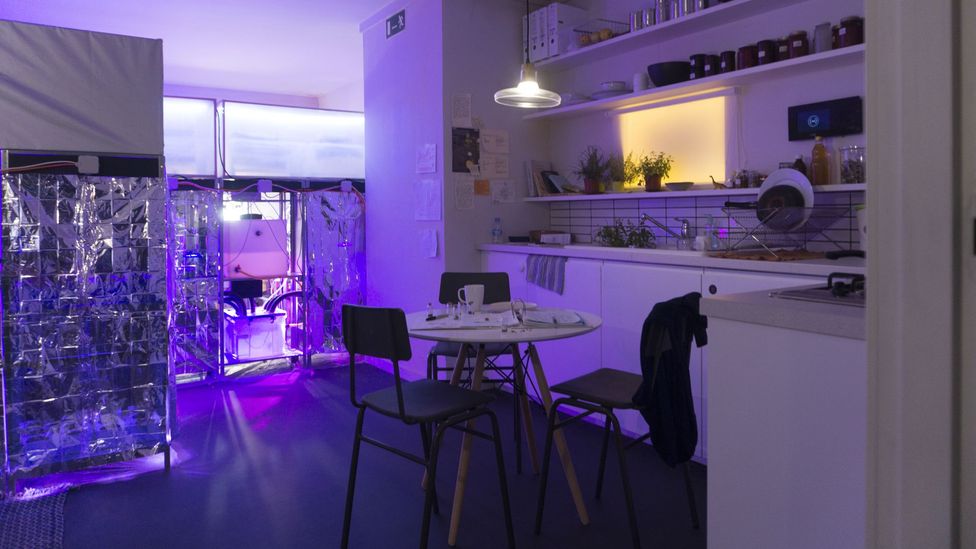
Superflux installation Mitigation of Stupor allowed visitors to immerse themselves in life an apartment in a dystopian future (Credit: Superflux)
For more positive visions of the future, take a film similar Black Panther, which shows a thriving environmentally-friendly, technologically advanced African culture that has never been colonised. Building on the work of writers like Octavia Butler, who placed people of colour at the center of science fiction, the film enables us to explore a future that moves across nowadays-day prejudices. As the second-highest grossing motion picture of 2018 and the most tweeted nearly movie ever, this kind of speculative piece of work clearly has the potential to influence our collective trajectory.
On a much more than local scale, projects similar Forest of the Hereafter in London'south Waltham Forest features speculative art and design work about the borough, such as screen-prints of time to come local by-laws by designer Cat Drew, to help decision-makers – politicians, citizens, consumers, voters, businesses – think about what a meliorate future can look similar, and how to achieve it.
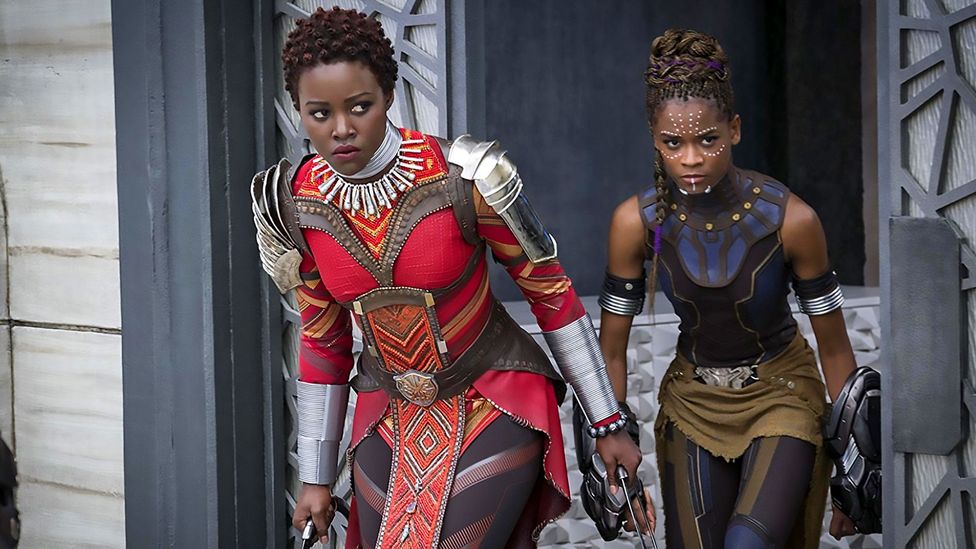
Black Panther showed what a more positive future could look like (Credit: Alamy)
The genius of art and civilization is that information technology allows u.s. to experience ideas about the futurity on an emotional and embodied level, not just an intellectual one. Take Olafur Eliasson's recent Ice Sentry, in which he transported melting glacial ice from the Arctic to London where the public could see and touch the blocks. "I believe that ane of the major responsibilities of artists – and the idea that artists have responsibilities may come as a surprise to some – is to help people not only get to know and sympathize something with their minds but besides to experience information technology emotionally and physically," Eliasson wrote in a 2016 article for Huffpost.
Often questions about the long-term future can experience distant and difficult for people to translate into meaningful activity in the context of their lives. It'due south ane thing to watch Black Panther in the movie house, and some other to know what its vision of the future ways in the context of your own life. Art and culture tin not but help us experience the long view, simply can provide cogitating space to enable us to accept action based on that agreement.
Somerset House'southward recent Earth Day season exemplifies this approach with its focus on "the role of linguistic communication and storytelling inpromoting collective action on the global climate crisis". Its mixture of immersive installations, screenings, workshops and debates enabled the public to both explore and reflect. In the words of the founder of the Climate Museum Bridget McKenzie: "We need to motility across seeing arts and culture in service to communication of climate activity, to thinking of it as a transformative and generative agent."
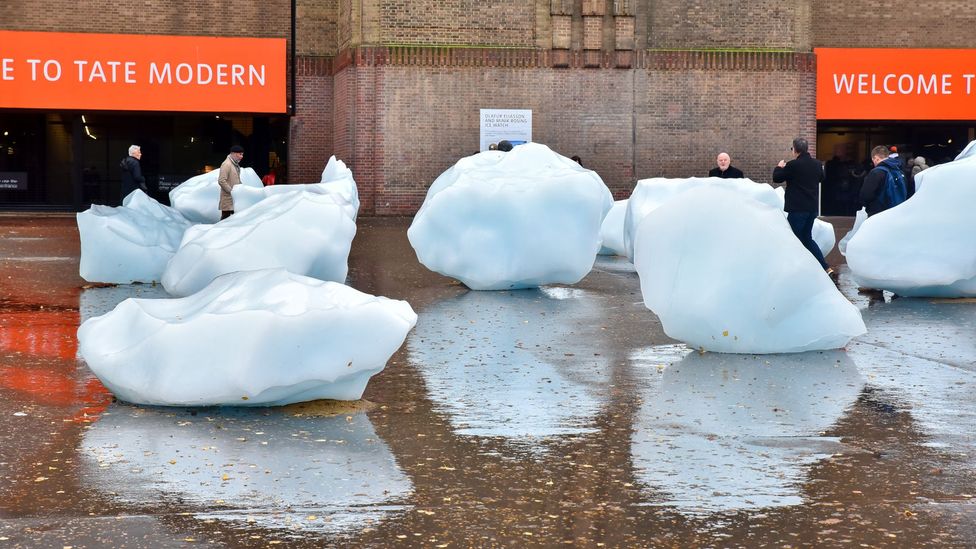
Olafur Eliasson placed melting iceberg pieces in forepart of the Tate Mod in London (Credit: Getty Images)
Nosotros Know Not What We May Be was a project at the Barbican in London developed by Zoë Svendsen of the arts system Metis. After a 20-infinitesimal talk from expert speakers from fields similar economics, geography and environmental science, the public was invited to explore what it would be like to live in an culling economic future, based on a fictional scenario devised from ane of these experts' enquiry. In an immersive "manufacturing plant of the hereafter" they grappled with their function in the shape of the future through storytelling and experimentation. In the words of Svendsen, the arts "can invite us to have on ways of operating without having to commit to them".
Or there's the work of interactive theatre company Coney, whose 2014 piece Early Days (of a better nation) involved no actors, only a participating audition who were told: "The state of war is over and the nation lies in ruins. You and your beau survivors must build the beginnings of a new country. What are the rules you're going to alive by? And can you avert the mistakes of the by?" The audience had to explore how they might organise themselves and run a country, testing and playing with new behaviours and scenarios.
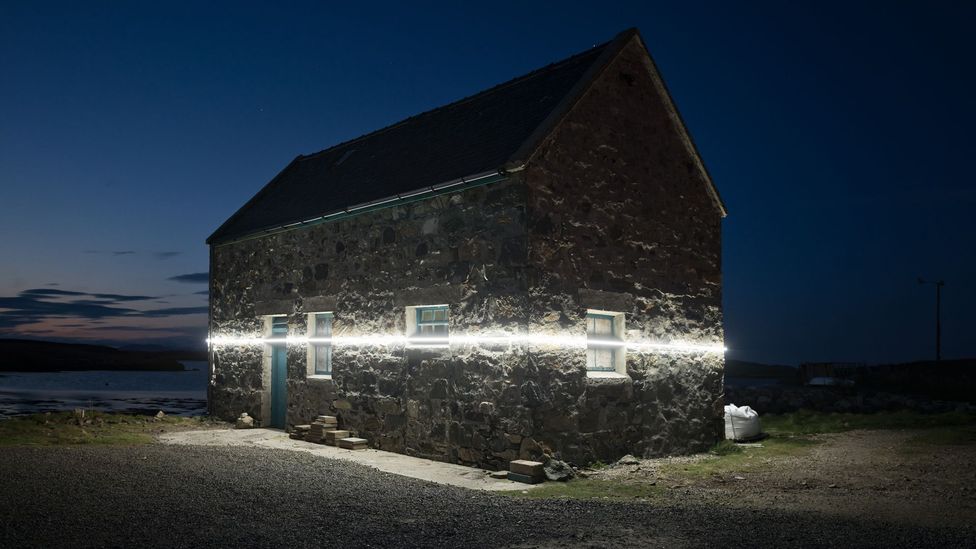
An installation by Finnish artists Pekka Niittyvirta and Timo Aho in the Outer Hebrides used low-cal to show the impact of sea level rise (Credit: Pekka Niittyvirta and Timo Aho)
Information technology's likely that acting in the interests of the long term will involve radical modify in the short term. Information technology volition involve rocking the boat, going against the norm, doing things very differently. Art and culture can help united states exercise this in many ways: by connecting us with previous moments of change to brand the radical feel more possible, by challenging the inevitability of the status quo, and by making radically unlike worlds feel tangible.
Art and culture can remind us that radical change has happened in the by. Information technology tin can both inspire us as to the scale of previous alter and it can remind us of the values and behaviours needed to make change happen. For instance, drama that retells previous movements of change like gay rights (Milk), civil rights (12 Years a Slave), or women'south rights (Suffragette) tin can make us feel more courageous, willing to put more on the line and have action.
Art tin also help usa challenge the status quo. Cultural theorist Mark Fisher wrote of art's part in challenging "the monopolisation of possible realities". Information technology can feel like the world nosotros live in is the but choice. Art and culture tin can expose us to a multiplicity of possible futures.
Take Economic Science Fictions, a new album exploring how science fiction can motivate new approaches to economics, or A People's Hereafter of the United States, with speculative stories that challenge oppression and envision new futures for the US. Speculative work tin can liberate us from the confines of pragmatism and to dream new futures. Fictions can fuel the future.
Culture too has the power to rapidly transport u.s. out of the confines of everyday life to create embodied experiencesof different possible futures. Back in the 1960s, the Situationists, a group of artists in Paris, pioneered work that created moments to jolt people out of their usual ways of thinking and acting. They demonstrated that art and civilisation can create spaces that temporarily suspend the established club, norms, and privileges. This was a facet of the recent Extinction Rebellion climate protests in the UK, which used art and culture to transform the roads and bridges they occupied in cardinal London. The hit pink gunkhole in Oxford Circus, Samba bands, verse, and impromptu performances from musicians all contributed to creating spaces that felt radically dissimilar from the norm.
Olafur Eliasson'southward the Conditions Project in the Tate Modern prompted meetings, celebrations, relaxation, noisy acts of protest, and silent contemplation (Credit: Getty Images)
Ultimately, we believe that challenging short-termism will involve reauthoring some of the deeper narratives that animate our guild, the collective beliefs that shape our direction of travel – from narratives about our place in the natural order of things to those which bulldoze our economical paradigms. The stories nosotros live in justify the status quo, make institutions feel inevitable, legitimise certain kinds of solutions, and make our world feel preordained. These cultural narratives are ofttimes foundational to the structures that incentivise short-termism, whether at the individual, political, corporate or financial level. For examples of this kind of narrative shift work, run into recent work on poverty by the Joseph Rowntree Foundation, the oceans by the Calouste Gulbenkian Foundation, and The Pop Culture Collaborative, which is underpinned by the belief that "activists, artists, and philanthropists can encourage mass audiences to reckon with the by and rewrite the story of our nation's future."
Civilization is foundational. Information technology is the soil from which our civilisations grow. If we want to ensure that humans have a long, thriving future on this planet, then we need to work at the level of culture too as politics, science, technology, finance and infrastructure. If we can piece of work with art and culture to stretch our time frames and then that we care virtually the long-term future, then hopefully as a species, we will take a future in the long term.
--
Ella Saltmarshe and Beatrice Pembroke are the founders of the Long Time Projection , which champions art and culture every bit a route to helping people think and act more than long-term. It is a new multidisciplinary initiative involving the creative and cultural industries, the humanities, science, media and business. Twitter: @LongTimeProject
Bring together more one million Future fans past liking united states on Facebook , or follow us on Twitter or Instagram .
If you liked this story, sign upward for the weekly bbc.com features newsletter , chosen "The Essential Listing". A handpicked selection of stories from BBC Future, Culture, Uppercase, and Travel, delivered to your inbox every Friday.
Source: https://www.bbc.com/future/article/20190521-how-art-and-culture-can-help-us-rethink-time

Post a Comment for "Art as a Method to Understand Past and Present Cultures"