Positive Installation Art We Are All a Part of the Same Thing
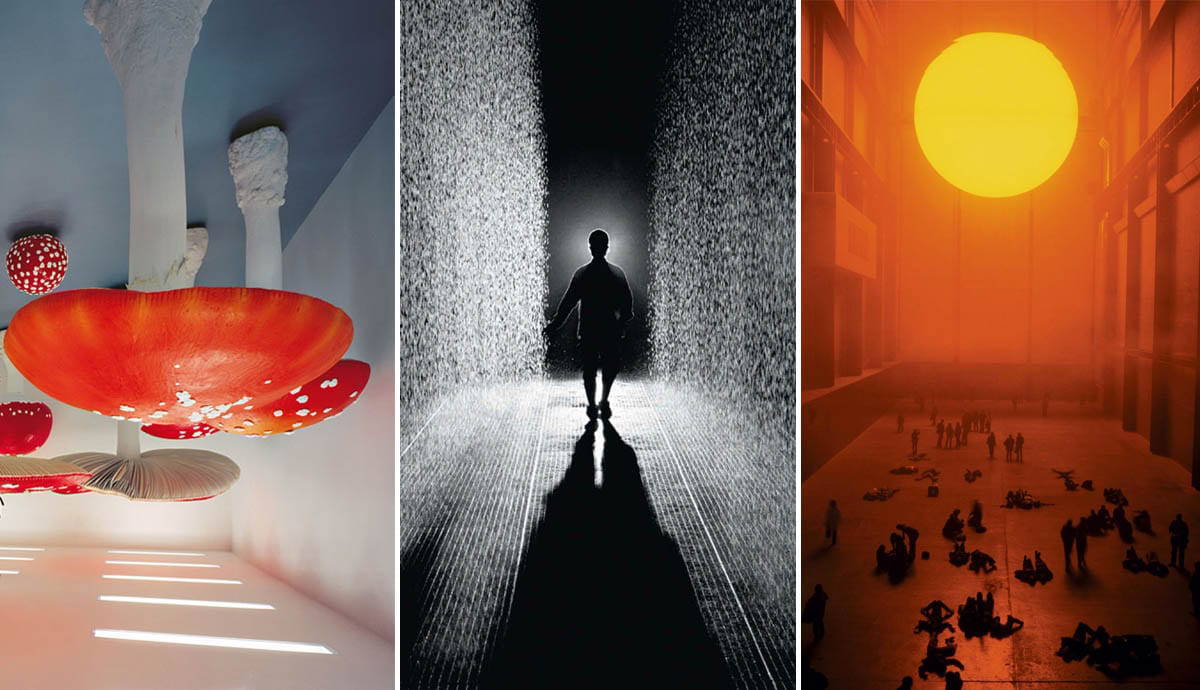
Installation art is 1 of the most powerful and immersive of all art forms. In dissimilarity with traditional mediums such as painting and sculpture, installation art is designed to fill whole rooms or even unabridged gallery spaces. Emerging equally a bona fide art move in the 1960s, installation fine art has since become one of the most pop and widespread strands of contemporary fine art practice, with artists embracing ever more adventurous and playful ways of transforming the gallery experience.
Many artists pattern tailor-made installation art to fit into a certain space, irresolute it into an entirely new arena. Scaffolding, imitation walls, mirrors, and even entire playgrounds accept filled contemporary fine art spaces, while light and audio furnishings are also a common feature. Audience interaction is a vital attribute of installation art; visitors take been encouraged to crawl nether huge towers, squeeze past behemothic mushrooms, or trigger sensors with the movement of their trunk. The ascent of digital technology has undoubtedly impacted this interactive strand of installation art, offering artists a vast wealth of new possibilities like never before.
A Brief History of Installation Art

Installation fine art arose as an art movement in the early 1960s, but earlier and so the seeds had already been sown. In 1923 Russian Constructivist El Lissitsky first explored the interaction between painting and architecture with his world-renowned Proun Room, where two and 3-dimensional geometric shards interact with one another in space. 10 years later German language Dada artist Kurt Schwitters began making his ongoing series of constructions titled Merzbau, 1933 from assembled panels of wood that seem to grow outwards from the walls. French Surrealist and Dada creative person Marcel Duchamp was too one of the commencement to playfully experiment with how visitors navigate a gallery space past filling information technology with a circuitous web in Mile of String, 1942.

In the 1950s 'happenings' were all the rage across the United States, with artists including Claes Oldenberg and Allan Kaprow merging experimental functioning art with crudely assembled objects, often with a politicized agenda. By the 1960s the term 'installation art' had been adopted by leading publications including Artforum, Arts Mag and Studio International to describe a huge rising trend for assemblages and environments. These artworks deliberately evaded the art market, since they were nearly incommunicable to sell and had to exist taken apart at the end of the exhibition. Instead, they have lived on through photographic documentation, known as an 'installation shot.'
Are y'all enjoying this article?
Sign upward to our Gratuitous Weekly Newsletter
Delight cheque your inbox to activate your subscription
Cheers!
Since this time installation art has remained a mainstay of gimmicky art practice and information technology is more diverse and experimental than ever. From prismatic displays of digital information to teetering towers on the brink of plummet, here are some of the most revolutionary and influential installations from throughout fine art history.
1. Allan Kaprow, Yard, 1961

American artist Allan Kaprow's Yard, 1961, signaled a new era in art history. The artist filled the outdoor backyard of New York's Martha Jackson Gallery to the brim with black rubber auto tires and tarpaper-wrapped forms before inviting willing participants to climb, jump and frolic like children in this giant playground. His iconic installation art opened upwards new, sensorial experiences for visitors and allowed them to appoint with art like never before. Also as exploring abstruse ideas effectually solids and voids in space, Kaprow besides brought improvisation and group participation into his art, taking it closer to the reality of ordinary life, equally he explains, "Life is much more interesting than art. The line between art and life should be kept as fluid, and perhaps indistinct, as possible."
2. Joseph Beuys, The Finish of the Twentieth Century, 1983-five

A giant of twentieth-century art , High german sculptor Joseph Beuys made The End of the Twentieth Century, 1983-85 just a year before he died. Xxx-one hulking rocks of basalt stone were gathered together and strewn across the flooring to create this installation art, each with its ain unique sense of history, weight and grapheme. Into each stone, Beuys drilled abroad a cylindrical hole in which he stuffed dirt and felt. He then polished and reattached the drilled away pieces, leaving but the slightest trace of his creative intervention in each one. In doing so, he collapsed together erstwhile/new, natural/human-made and difference/repetition. Beuys also referenced the dawn of a new century still weighed down past history as heavy as his basalt rocks, commenting, "This is the stop of the twentieth century. This is the old world, on which I printing the stamp of the new globe."
3. Cornelia Parker, Cold Nighttime Thing: An Exploded View, 1991

British artist Cornelia Parker'southward Cold Night Matter: An Exploded View, 1991, is 1 of the nigh striking and memorable installation artworks of recent times. To create this work, Parker filled an old shed with domestic junk including old toys and tools, before having the unabridged shed exploded in a field by the British Army. She then gathered together all the fragments left behind and suspended them mid-air every bit if permanently suspended in the 'b' of the bang. When set amidst eerie lighting these once familiar items get bathetic and unrecognizable fragments, while the championship 'Common cold Dark Matter' further emphasizes a sense of gothic mystery, referencing what Parker calls, "matter in the universe that hasn't yet been measured."
4. Damien Hirst, Pharmacy, 1992

Designed to resemble the cool, clinical atmosphere of an old-fashioned pharmacy, Damien Hirst 's Chemist's, 1992 contains a vast arrangement of pill packets, bottles and medical instruments set amidst an austere white backdrop. But his installation art is far too geometric and ordered to be existent, with boxes and packages arranged into a neatly gridded system to resemble the make clean purity of Minimalist art . Arranging pill packets into repeat patterns of enticingly bright colors highlights the seductive nature of pharmaceutical products, lending them all the desirability and danger of a sweet shop. This seductive quality of Hirst's installation highlights our modernistic-day obsession with medicine as a tool to extend our life expectancy without question, as Hirst explains, "Nosotros all die, so this kind of large happy, smiling, minimal, colorful, confident facade that medicine and drug companies put upwards is not flawless – your body lets you down, but people want to believe in some kind of immortality."
5. Carsten-Höller, Mushroom Room, 2000

With all the magical mystery of a childhood fairy-tale, Belgian creative person Carsten Holler'due south Mushroom Room, 2000 is a treat for the senses. Holler deliberately selected the scarlet-and-white agaric fungus because of its psychoactive qualities, grossly exaggerating their size, colors, and textures to amplify their dramatic impact. Suspending them from the ceiling upside downwards forces visitors to squeeze and duck their way through them, turning this installation art into an interactive experience that engages the entire body and mind. Holler likens the transformative ability of these mushrooms to the act of viewing and interacting with a work of art, arguing both can induce the same listen-altering feel of imaginative awakening that is at the core of artistic thinking.
6. Olafur Eliasson, The Atmospheric condition Project, 2003
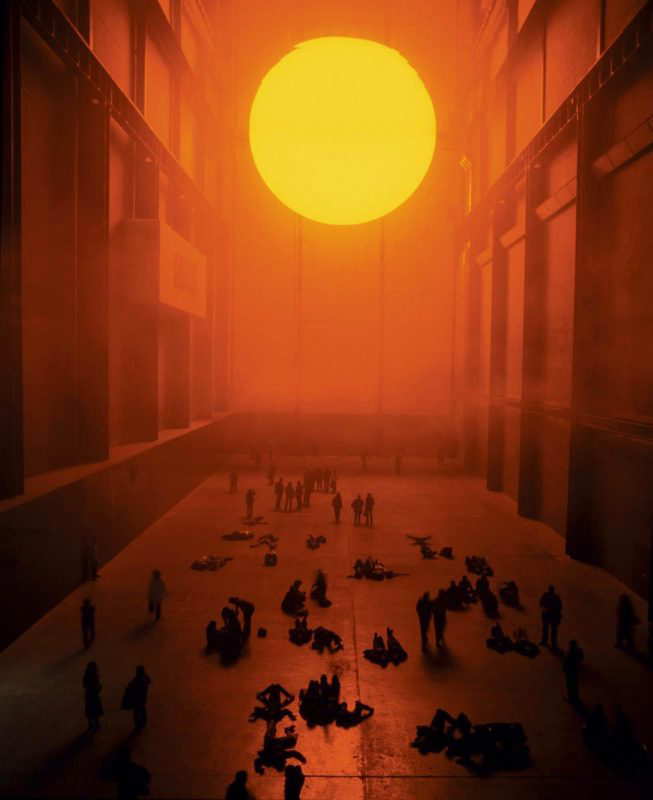
Danish-Icelandic creative person Olafur Eliasson designed his impressively aggressive installation artwork The Weather Projection, 2003 for Tate Modern'due south Turbine Hall, replicating the effect of a huge lord's day emerging through a fine mist. Depression-frequency lamps around his artificial sun immune only the golden glow of the sunday to dominate the space, reducing all surrounding colors to the magical shades of aureate and black. Chief of illusion, Eliasson made his glowing orb from a semi-circle of calorie-free which is reflected by mirrored panels on the ceiling that complete the circumvolve, lending the upper half of the sun a hazy, shimmering quality that mimics the real sun. These mirrored panels connected across the entire ceiling, allowing visitors to see themselves reflected as if floating in the sky above them, creating the sensation of hovering weightlessly in infinite.
7. Anish Kapoor, Svayambh, 2007
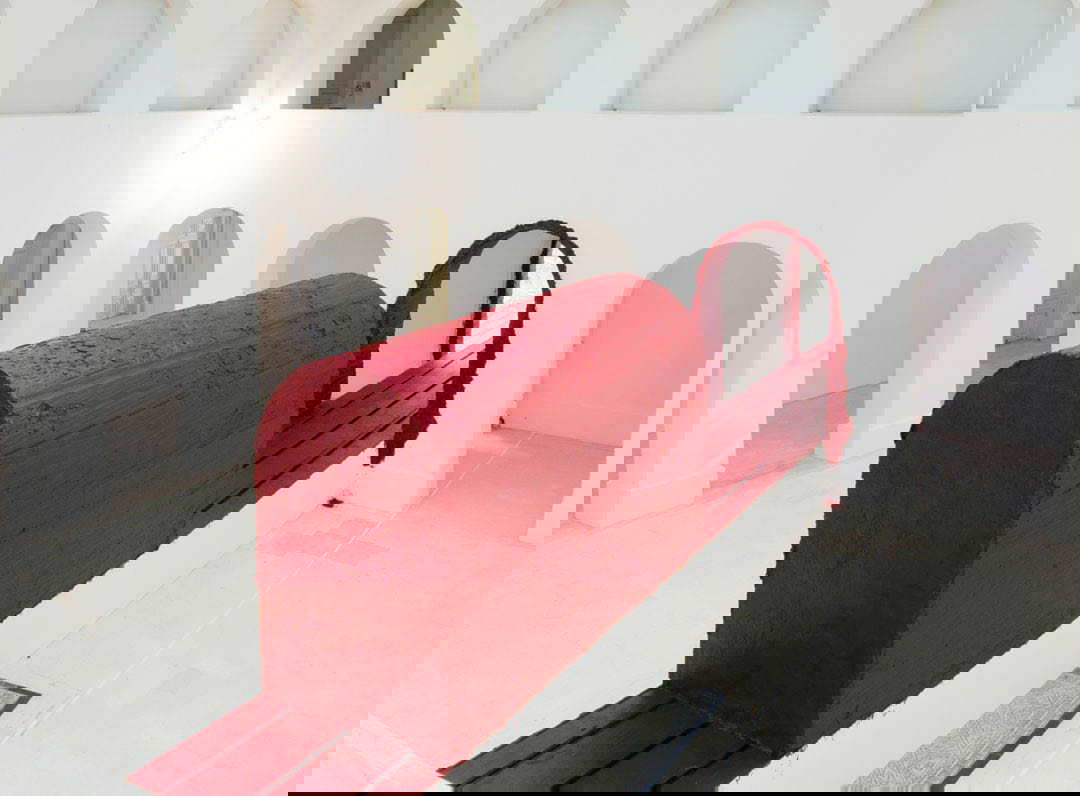
Described past art critic Adrian Searle as "a very fine mess," British-Indian sculptor Anish Kapoor's Svayambh, 2007, is both ludicrous and astonishing. Fabricated from 30 tonnes of soft wax and pigment, a slow train moves back and along on a specially designed rail between the pristine arches of the museum (he has made several versions for different institutions) leaving in its wake an unbelievably messy trail of sticky, gooey matter. Kapoor'southward installation art 'train' is a jumbo ten meters long and ignites our senses on numerous levels, through texture, surface, smell, and color; the distinctive shade of archaic cherry seen in this and many of his other works seems tied to our nigh basic and fundamental human instincts.
8. Yayoi Kusama, Infinity Mirrored Room – The Souls of Millions of Lite Years Away, 2013

Japanese artist Yayoi Kusama 'south Infinity Mirrored Room – The Souls of Millions of Low-cal Years Away, 2013 is one of many immersive 'Infinity Rooms' which have fascinated gallery-goers effectually the world. Made by installing mirrored panels effectually the walls, ceiling, and floors of a small-scale, enclosed space, Kusama then fills it with tiny networks of colored lights or objects that refract around the room and create the effect of endless, infinite space. Visitors inbound her room walk along a mirrored walkway and see prismatic reflections of themselves scattered all around the room, surrounded by colored lite. Much like inbound a star-filled universe or merging into the digital superhighway, at that place's nothing quite like the experience of an Infinity Room.
ix. Random International, Rain Room, 2013

Random International's much-celebrated installation artwork Pelting Room, 2013, concisely merges art and engineering science into one. Visitors tin can laissez passer through a gushing torrent of rainwater but miraculously remain dry, as sensors detect their movement and cause the rain to stop around them. This deceptively simple thought from the London-based collective embraces a natural symbiosis between art and viewer every bit the installation only comes live through concrete appointment. The artists of Studio International also tap into the primal role of technology in harnessing and stabilizing our natural environs, suggesting we can have a positive and mutually beneficial relationship with our landscape, rather than exploiting it for personal short-term proceeds. Fabricated for temporary gallery spaces around the world, the outset permanent installation of Rain Room was installed at the Sharjah Fine art Foundation in the United Arab Emirates in 2018.
10. Phyllida Barlow, Dock, 2014

In Phyllida Barlow's Dock, 2014, fabricated for Tate U.k., a series of huge haphazard assemblages fabricated from institute debris are nailed together and suspended effectually the room. Piles of bit forest are hastily tacked together to form flimsy-looking scaffolding, onto which bundles of brightly colored fabric, old trash bags, and discarded habiliment are spring with reams of colored tape. There is something ridiculously playful and highly-seasoned about Barlow'due south knocked-up arrangements, tapping into a child-like desire to construct something from nothing. But more than importantly, the sense of urgency and flux her upcycled arrangements create seems to reverberate the anxious instability of living in the contemporary urban surroundings.
The Legacy of Installation Art

Since its conception, installation fine art has remained 1 of the virtually dominating mediums of contemporary art. With advancing technologies, more than artists are now focussing on interactive digital installations, and this advancement has opened doors to entirely new possibilities for installation fine art and its relevance in today's society. Its unifying ability and immersive connection with the viewer makes installation fine art a revelation that continues to constantly reinvent itself.
Source: https://www.thecollector.com/what-is-installation-art/

Post a Comment for "Positive Installation Art We Are All a Part of the Same Thing"